A €10 contribution allows us to deliver 2 hours of school orientation workshops for teachers. A €20 contribution allows us to deliver 4 hours of awareness workshops for families. A €50 contribution allows us to deliver 3 hours of mental health workshops with teenagers.
Charco Rico: Caring for Mental Health in a Rural Community After the Earthquake
This is some text inside of a div block.
In Colombia's Tolima department, about an hour and a half from Ibagué, lies Charco Rico, a rural community where long distances are part of everyday life. Some students at the rural campus of the Institución Educativa San Francisco walk up to an hour and a half to get to class.
This geographic reality matters when it comes to mental health. Access to resources and services is not the same in rural and urban areas, and Colombia recognizes this inequality as a structural challenge. Among its aims, the Ministry of Health and Social Protection's National Rural Health Plan seeks to close the gap between countryside and city and to improve effective access to quality health services in rural and remote rural areas.
A Rural Reality Shaped by Inequality
Complex socioeconomic conditions are part of this context. According to DANE data, in 2018 multidimensional poverty stood at 38.6% in the populated centers and dispersed rural areas of Ibagué, compared with 13.2% in the municipal seat. This figure covers the municipality's rural population as a whole, not Charco Rico alone, but it helps illustrate the territorial inequalities affecting rural communities across Colombia.
Against this backdrop, bringing well-being and mental health support closer to communities takes on particular importance. Colombia's national mental health policy provides for protective family and community environments, stronger support networks, early detection, and timely access to care pathways.
A Community Hit by the Earthquake
Then an emergency struck.
On August 10, 2026, a magnitude 7.4 earthquake with its epicenter in San José del Palmar, Chocó, caused damage in 28 municipalities across Tolima, mainly to roads, homes, and schools.
In the first days after the quake, the Tolima Governor's Office reported damage to 336 public schools in the area, 18 of which required repairs before they could receive students again. In-person classes were suspended while safety inspections were carried out.
The impact of an emergency of this scale is not only material. The World Health Organization notes that emergencies cause psychological distress, disrupt support networks, and make it harder to access mental health services. Its international guidance includes community-based psychosocial support, alongside specialized care where needed.
Embracing Hope Comes to Charco Rico
It is in this context that Abrazando la Esperanza (Embracing Hope) is taking shape: a YumaKids strategy aimed at strengthening mental health care from within the community.
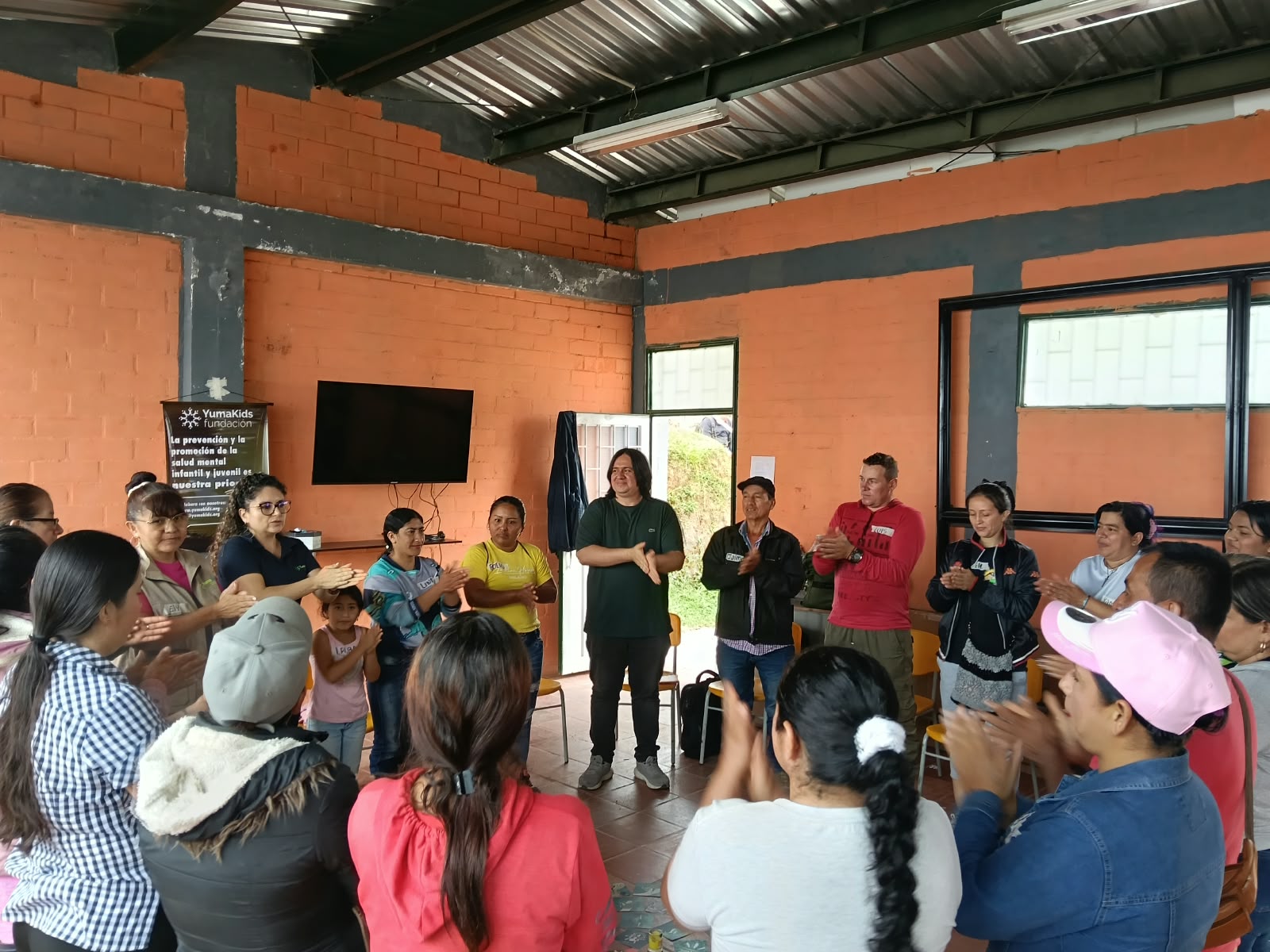
Charco Rico's campus was prioritized by the school itself because of the damage it suffered in the earthquake. YumaKids, which had already been supporting this school community with mental health materials and workshops, held a new session for students, families, and teachers built around the Mindcare Crisis Pack.
Participants:
35 secondary school students
20 parents
49 teachers from the school
With the students, the team worked through a range of reflection and self-care tools. These included the Improvement Card, on which each student identifies one concrete action to look after their mental health, and the Circle of Light, a closing activity built on commitment, mutual support, and collective solidarity.
The sessions, led by mental health professionals, also included a dedicated space for families and work with teachers, extending the intervention to the whole school community.
Despite heavy rain throughout the day, most participants came to the session, many of them traveling long distances outside school hours.
For YumaKids, this experience reflects a conviction: mental health care must also reach rural communities and take into account the specific conditions in which people live.
Abrazando la Esperanza (Embracing Hope) is not intended to replace specialized care where it is needed. It aims to strengthen protective factors, promote self-care, create spaces for listening, and build communities' capacity to cope with crisis situations.
.jpeg)

.jpg)
.jpg)